
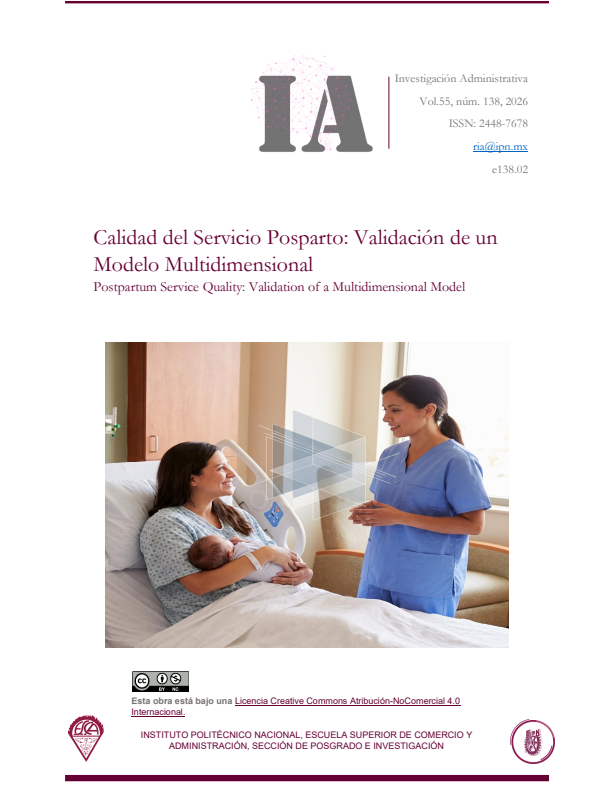
Calidad del Servicio Posparto: Validación de un Modelo Multidimensional
Barra lateral del artículo
Contenido principal del artículo
Resumen
El objetivo del artículo es validar un modelo multidimensional para evaluar la calidad del servicio maternal posparto en hospitales públicos de Hidalgo, México. Como método, se empleó un enfoque mixto con diseño exploratorio secuencial (DEXPLOS): la fase cualitativa identificó seis dimensiones y permitió construir un instrumento de 24 ítems; la fase cuantitativa incluyó validez de contenido, confiabilidad interna, AFE, AFC y regresión múltiple. Los resultados muestran un modelo factorial confirmatorio con ajuste adecuado (CFI = 0.938; RMSEA = 0.066). En los hallazgos la regresión múltiple explicó el 85.6% de la varianza de la calidad percibida, con mayores coeficientes en apoyo emocional, comunicación y educación sobre signos de alarma. La originalidad radica en aportar un modelo validado para evaluar la atención posparto y orientar estrategias de innovación tecnológica centradas en la experiencia de la paciente. Las limitaciones incluyen muestreo no probabilístico y aplicación en un solo estado de México.
Detalles del artículo

Esta obra está bajo una licencia internacional Creative Commons Atribución-NoComercial 4.0.
Citas
Afulani, P. A., Oboke, E. N., Ongeri, L., Weiss, S. J., Lyndon, A., & Berry Mendes, W. (2021). Understanding disparities in person-centred maternity care: The potential role of provider implicit and explicit bias. Health Policy and Planning, 36(3), 298–311. https://doi.org/10.1093/heapol/czaa190
Aiken, L. R. (1980). Content validity and reliability of single items or questionnaires. Educational and Psychological Measurement, 40(4), 955–959. https://doi.org/10.1177/001316448004000419
Aranda, Z., Caamal, V., Montaño, M., Bernal, D., & Meneses, S. (2024). Exploring how non-clinical factors in childbirth care shape users’ experiences in public health facilities in rural Chiapas, Mexico: A qualitative study using the WHO health systems responsiveness framework. BMC Pregnancy and Childbirth, 24(1), 173. https://doi.org/10.1186/s12884-024-06357-7
Arias, M. P., Wang, E., Leitner, K., Sannah, T., Keegan, M., Delferro, J., . . . Hamm, R. (2022). The impact on postpartum care by telehealth: A retrospective cohort study. American Journal of Obstetrics & Gynecology MFM, 4(3). https://doi.org/10.1016/j.ajogmf.2022.100611
Baart, A., Brunsveld Reinders, A., Pijnappel, L., de Haan, M., & de Man-van Ginkel, J. (2025). Continuity of care as central theme in perinatal care: A systematic review. Midwifery, 141(104273). https://doi.org/10.1016/j.midw.2024.104273
Bujang, M., Omar, E., & Baharum, N. (2018). A review on sample size determination for Cronbach’s alpha test: A simple guide for researchers. Malaysian Journal of Medical Sciences, 25(6), 85–99. https://doi.org/10.21315/mjms2018.25.6.9
Contreras-Sánchez, S., Doubova, S., Mejía-Chávez, M., Infante-Castañeda, C., & Pérez-Cuevas, R. (2022). Factores asociados a la falta de control posnatal materno [Factors associated with a lack of postnatal care]. Revista Médica del Instituto Mexicano del Seguro Social, 60(1), 4–11.
Creamer, E. (2022). An introduction to fully integrated mixed methods research (2nd ed.). SAGE Publications, Inc. https://doi.org/10.4135/9781071802823
Creswell, J., & Plano Clark, V. (2018). Designing and conducting mixed methods research (3rd ed.). SAGE Publications, Inc.
Cronbach, L. (1951). Coefficient alpha and the internal structure of tests. Psychometrika, 16(3), 297-334. https://doi.org/10.1007/BF02310555
DiStefano, C., & Morgan, G. (2014). A comparison of diagonal weighted least squares robust estimation techniques for ordinal data. Structural Equation Modeling, 21(3), 425–438. https://doi.org/10.1080/10705511.2014.915373
Doubova, S., Leslie, H., Pérez-Cuevas, R., Kruk, M., & Arsenault, C. (2024). Users’ perception of quality as a driver of private healthcare use in Mexico: Insights from the People’s Voice survey. PLOS ONE, 19(6), e0306179. https://doi.org/10.1371/journal.pone.0306179
Escobar, J., & Cuervo, A. (2008). Validez de contenido y juicio de expertos: Una aproximación a su utilización. Avances en Medición, 6, 27–36. Retrieved from http://revistas.um.es/advances/article/view/48161
Fetters, M. (2020). The mixed methods research workbook: Activities for designing, implementing, and publishing projects. SAGE Publications, Inc. https://doi.org/10.4135/9781071909713
Flora, D., & Curran, P. (2004). An empirical evaluation of alternative methods of estimation for confirmatory factor analysis with ordinal data. Psychological Methods, 9(4), 466–491. https://doi.org/10.1037/1082-989X.9.4.466
Galle, A., Moran, A., Bonet, M., Graham, K., Muzigaba, M., Portela, A., . . . Moller, A.-B. (2023). Measures to assess quality of postnatal care: A scoping review. PLOS Global Public Health, 3(2), e0001384. Retrieved from https://doi.org/10.1371/journal.pgph.0001384
GmbH. (2026). ATLAS.ti [Qualitative data analysis software]. Retrieved from https://atlasti.com
Hayes, A., & Coutts, J. (2020). Use omega rather than Cronbach’s alpha for estimating reliability. But…. Communication Methods and Measures, 14(1), 1–24. https://doi.org/10.1080/19312458.2020.1718629
INEGI, I. (2022). Estadísticas de mortalidad materna 2018–2022. Retrieved from https://www.inegi.org.mx/sistemas/olap/Proyectos/bd/continuas/mortalidad/MortalidadGeneral.asp
Instituto Mexicano del Seguro Social [IMSS]. (2019). Vigilancia y atención amigable en el trabajo de parto en embarazo de bajo riesgo (IMSS-052-19) [Guía de práctica clínica]. Retrieved from https://www.imss.gob.mx/sites/all/statics/guiasclinicas/052GER.pdf
International Organization for Standardization [ISO]. (2015). ISO 9000:2015(es) Sistemas de gestión de la calidad — Fundamentos y vocabulario. Retrieved from https://www.iso.org/obp/ui#iso:std:iso:9000:ed-4:v1:es
Jamovi: Computer software. (2025). Retrieved from https://www.jamovi.org
Jonkisz, A., Karniej, P., & Krasowska, D. (2022). The SERVQUAL method as an assessment tool of the quality of medical services in selected Asian countries. International Journal of Environmental Research and Public Health, 19(13). https://doi.org/10.3390/ijerph19137831
Kline, R. B. (2023). Principles and practice of structural equation modeling (5th ed.). The Guilford Press.
Kruk, M., Gage, A., Arsenault, C., Jordan, K., Leslie, H., & Roder-DeWan, S. (2018). High-quality health systems in the Sustainable Development Goals era: Time for a revolution. The Lancet Global Health, 6(11), e1196–e1252. https://doi.org/10.1016/S2214-109X(18)30386-3
Lieber, E., & Weisner, T. (2010). Meeting the practical challenges of mixed methods research. In Handbook of mixed methods in social & behavioral research (pp. 559–579). SAGE.
National Academies of Sciences, Engineering, and Medicine. (2021). The future of nursing 2020–2030: Charting a path to achieve health equity. National Academies Press. https://doi.org/10.17226/25982
Nuwabaine, L., Namulema, A., Sserwanja, Q., Kawuki, J., Amwiine, E., & Amperiize, M. (2024). Factors associated with quality of postnatal care in Kenya: An analysis of the 2022 Kenya DHS. Archives of Public Health, 82(1), 227. https://doi.org/10.1186/s13690-024-01433-y
OCDE/Eurostat. (2018). Manual de Oslo 2018: Guidelines for Collecting, Reporting and Using Data on Innovation, 4th Edition. OECD Publishing. https://doi.org/10.1787/9789264304604-en
OECD. (2023). OECD science, technology and innovation outlook 2023. https://doi.org/10.1787/0b55736e-en
OECD. (2024). Global Trends in Government Innovation 2024: Fostering Human-Centred Public Services. https://doi.org/10.1787/c1bc19c3-en.
Paredes-Cruz, M., Perez-Moran, D., Doubova, S., Arsenault, C., & Quinzaños-Fresnedo, C. (2025). Quality of postnatal care for mothers and neonates in Mexico: Insights from the maternal eCohort study. PLOS ONE, 20(8), e0323039. https://doi.org/10.1371/journal.pone.0323039
Penfield, R., & Giacobbi, P. (2004). Applying a score confidence interval to Aiken’s item content-relevance index. Measurement in Physical Education and Exercise Science, 8(4), 213–225. https://doi.org/10.1207/s15327841mpee0804_3
Repke, L., Birkenmaier, L., & Lechner, C. (2024). Validity in survey research – From research design to measurement instruments. GESIS – Leibniz Institute for the Social Sciences. https://doi.org/10.15465/gesis-sg_en_048
Rivas-Tovar, L. (2025). Normas APA 7.ª edición: estructura, citas y referencias. Instituto Politécnico Nacional. Retrieved from https://www.researchgate.net/publication/357046089_NORMAS_APA_7_EDICION_ESTRUCTURA_CITAS_Y_REFERENCIAS
Secretaría de Salud. (2016, 4 7). Norma Oficial Mexicana NOM-007-SSA2-2016, para la atención de la mujer durante el embarazo, parto y puerperio, y de la persona recién nacida. Retrieved from Diario Oficial de la Federación: https://www.dof.gob.mx/nota_detalle.php?codigo=5432289
Secretaría de Salud. (2026). Mortalidad materna: Semana epidemiológica 03 [Boletín]. Retrieved from Gobierno de México.: https://www.gob.mx/cms/uploads/attachment/file/1052006/MM_2026_SE03_1_.pdf
Sudhinaraset, M., Landrian, A., Golub, G., Cotter, S., & Afulani, P. (2021). Person-centered maternity care and postnatal health: Associations with maternal and newborn health outcomes. The Lancet Regional Health – Americas, 1, 100005. https://doi.org/10.1016/j.xagr.2021.100005
Symon, A., Mortensen, B., Pripp, A., Chhugani, M., Adjorlolo, S., Badzi, C., . . . Cummins, A. (2025). Validating the Quality Maternal and Newborn Care Framework index: A Global Tool for Quality-of-Care Evaluations. Birth, 52: 347-352, 1–15. https://doi.org/10.1111/birt.12895
Tavakol, M., & Dennick, R. (2011). Making sense of Cronbach’s alpha. International Journal of Medical Education, 2, 53–55. https://doi.org/10.5116/ijme.4dfb.8dfd
Tormen, M., Toniolo, B., Pecci, L., Soraci, G., Taliento, C., Greco, P., & Salvioli, S. (2024). Exploring the impact of integrating telehealth in obstetric care: A scoping review. European Journal of Obstetrics & Gynecology and Reproductive Biology, 302, 242-248. https://doi.org/10.1016/j.ejogrb.2024.09.031
World Health Organization. (2022). WHO recommendations on maternal and newborn care for a positive postnatal experience. Retrieved from https://www.who.int/publications/i/item/9789240045989
World Health Organization. (2025). Quality health services. Retrieved from https://www.who.int/news-room/fact-sheets/detail/quality-health-services