
System Dynamics: Digital Absorptive Capacity in Advanced Manufacturing
Article Sidebar
Main Article Content
Abstract
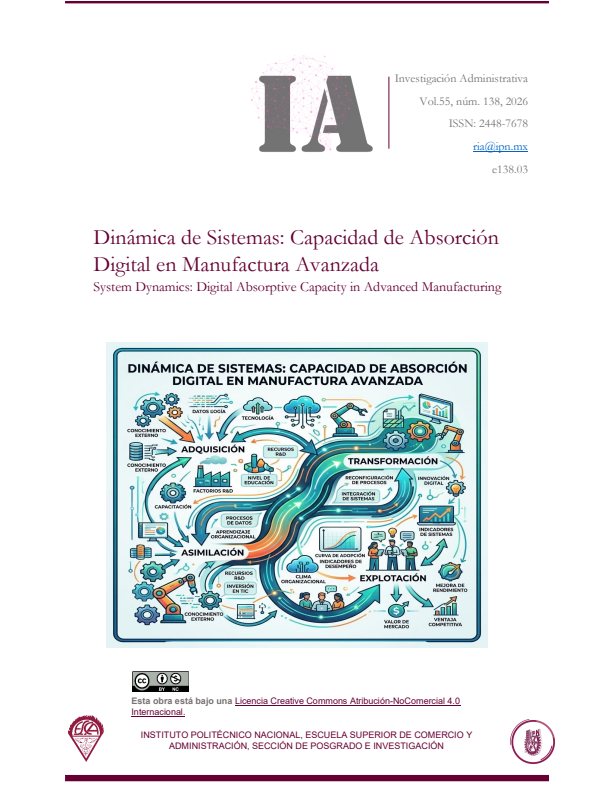
The objective of this study is to analyze Digital Absorptive Capacity in advanced manufacturing to resolve the productivity paradox under the Complex Systems approach. The research method is quantitative, utilizing System Dynamics and Python simulation to evaluate scenarios over a 60-month horizon. The simulation results suggest that knowledge tends to converge in the long term, while human talent appears to act as a structural constraint on technological investment. The findings identify a temporal asynchrony where inefficient management generates delays of up to 17 months, invalidating the industrial window of opportunity. The originality lies in the mathematical formalization of the asynchrony between organizational learning cycles and technological obsolescence. The limitation of the study is the model assumes that investment remains constant, without considering external financial volatility or stochastic crises in the manufacturing sector.
Article Details

This work is licensed under a Creative Commons Attribution-NonCommercial 4.0 International License.
References
Abourokbah, S. H., Mashat, R. M., & Salam, M. A. (2023). Role of Absorptive Capacity, Digital Capability, Agility, and Resilience in Supply Chain Innovation Performance. Sustainability, 15(4), 3636. https://doi.org/10.3390/su15043636
Acosta-Prado, J. C., López-Montoya, O. H., & Tafur-Mendoza, A. A. (2024). The Mediating Role of Knowledge Generation Between Training and Development of Human Talent and Innovative Performance. VINE Journal of Information and Knowledge Management Systems, 54(4), 916–929. https://doi.org/10.1108/VJIKMS-12-2021-0309
Atalay, M., Murat, U., Oksuz, B., Parlaktuna, A. M., Pisirir, E., & Testik, M. C. (2022). Digital Twins in Manufacturing: Systematic Literature Review for Physical–Digital Layer Categorization and Future Research Directions. International Journal of Computer Integrated Manufacturing, 35(7), 679-705. https://doi.org/10.1080/0951192X.2021.2022762
Ates, A., & Acur, N. (2022). Making Obsolescence Obsolete: Execution of Digital Transformation in a High-Tech Manufacturing SME. Journal of Business Research, 152, 336-348. https://doi.org/10.1016/j.jbusres.2022.07.052
Babkin, A., Shkarupeta, E., Mamrayeva, D., Tashenova, L., Umarov, A., & Karimov, D. (2025). A Structural-Functional Model for Managing Digital Maturity in a Cluster-Based, Innovation-Active Industrial Ecosystem Within Industry 5.0. International Journal of Technology, 16(2), 1209-1219. https://doi.org/10.14716/ijtech.v16i4.7412
Barlas, Y. (2025). Teaching and Advising in Systems Science and System Dynamics - Personal Experience, Lessons, and Reflections. System Dynamics Review, 41(2), e70003. https://doi.org/10.1002/sdr.70003
Belso-Martínez, J., Expósito-Langa, M., & Tomás-Miquel, J. (2016). Knowledge Network Dynamics in Clusters: Past Performance and Absorptive Capacity. Baltic Journal of Management, 11(3), 310–327. https://doi.org/10.1108/BJM-02-2015-0044
Boroomand, F., & Chan, Y. E. (2024). Digital Absorptive Capacity: Developing an Instrument. Knowledge Management Research & Practice, 22(1), 61-72. https://doi.org/10.1080/14778238.2022.2139773
Bosco, F. A. (2022). Accumulating Knowledge in the Organizational Sciences. Annual Review of Organizational Psychology and Organizational Behavior, 9(1), 441-464. https://doi.org/10.1146/annurev-orgpsych-012420-090657
Brito, N. A., Cartagena, H. R., Arévalo, C. G., & Ortega, J. R. (2025). Optimization of the Mixing Process in Carbonated Beverages Using Differential Equation Models Simulated With Python. Polo del Conocimiento, 10(12), 2712-2827. https://doi.org/10.23857/pc.v10i12.10974
Broekema, W. (2025). Conceptualizing Organizational Forgetting in a Crisis Context. Risk, Hazards & Crisis in Public Policy, 16(2), e70007. https://doi.org/10.1002/rhc3.70007
Chang, C. H. (2025). Digital Transformation Anxiety: Absorptive Capacity, Dynamic Capability, and Digital Innovation Performance. Management Decision, 63(3), 734-755. https://doi.org/10.1108/MD-08-2023-1363
Coen, C. A., & Maritan, C. A. (2011). Investing in Capabilities: The Dynamics of Resource Allocation. Organization Science, 22(1), 99-117. https://doi.org/10.1287/orsc.1090.0524
Coffie, R. B., Boateng, K. A., & Alhassan, A. U. (2023). Knowledge Management Practices for Enhanced Organisational Performance: Can Leadership Style Be a Moderator?. Electronic Journal of Knowledge Management, 21(1), 13-28. https://doi.org/10.34190/ejkm.21.1.2771
Cohen, W. M., & Levinthal, D. A. (1990). Absorptive Capacity: A New Perspective on Learning and Innovation. Administrative Science Quarterly, 35(1), 128-152. https://doi.org/10.2307/2393553
Corsaro, D., Vargo, S. L., Hofacker, C., & Massara, F. (2022). Artificial Intelligence and the Shaping of the Business Context. Journal of Business Research, 145, 210-214. https://doi.org/10.1016/j.jbusres.2022.02.072
Dahiyat, S. E., Khasawneh, S. M., Bontis, N., & Al-Dahiyat, M. (2023). Intellectual Capital Stocks and Flows: Examining the Mediating Roles of Social Capital and Knowledge Transfer. VINE Journal of Information and Knowledge Management Systems, 53(1), 11–42. https://doi.org/10.1108/VJIKMS-06-2020-0110
Demeter, K., Losonci, D., & Nagy, J. (2021). Road to Digital Manufacturing - A Longitudinal Case-Based Analysis. Journal of Manufacturing Technology Management, 32(3), 820–839. https://doi.org/10.1108/JMTM-06-2019-0226
Demuner Flores, M. (2021). Gestión del Conocimiento en la Innovación en Pequeñas Empresas de Manufactura. Revista Venezolana de Gerencia, 26(95), 741-757.
Dieste, M., Orzes, G., Culot, G., Sartor, M., & Nassimbeni, G. (2024). The “Dark Side” of Industry 4.0: How Can Technology Be Made More Sustainable? International Journal of Operations & Production Management, 44(5), 900–933. https://doi.org/10.1108/IJOPM-11-2022-0754
Epure, M., Martin‐Sanchez, V., Aparicio, S., & Urbano, D. (2024). Human Capital, Institutions, and Ambitious Entrepreneurship During Good Times and Two Crises. Strategic Entrepreneurship Journal, 18(2), 414-447. https://doi.org/10.1002/sej.1492
Fabio, G., Giuditta, C., Margherita, P., & Raffaeli, R. (2025). A Human-Centric Methodology for the Co-Evolution of Operators’ Skills, Digital Tools and User Interfaces to Support the Operator 4.0. Robotics and Computer-Integrated Manufacturing, 91, 102854. https://doi.org/10.1016/j.rcim.2024.102854
Gavrikova, E., Volkova, I., & Burda, Y. (2022). Implementing Asset Data Management in Power Companies. International Journal of Quality & Reliability Management, 39(2), 588-611. https://doi.org/10.1108/IJQRM-10-2020-0346
Gheitarani, F., Guevara, R., Nawaser, K., & Jahanshahi, A. A. (2022). Identifying Dimensions of Dynamic Technological Capability: A Systematic Review of the Last Two Decades of Research. International Journal of Innovation and Technology Management, 19(4), 2230002. https://doi.org/10.1142/S0219877022300026
Giannakos, M. N., Mikalef, P., & Pappas, I. O. (2022). Systematic Literature Review of E-Learning Capabilities to Enhance Organizational Learning. Information Systems Frontiers, 2(4), 619-635. https://doi.org/10.1007/s10796-020-10097-2
Gozali, L. Z., Sutopo, W., Gunawan, A., Liang, Y., Yahya, B. N., Garza-Reyes, J. A., . . . Suseno, Y. (2024). The Important Role of System Dynamics Investigation on Business Model, Industry and Performance Management. International Journal of Productivity and Performance Management, 73(4), 945–980. https://doi.org/10.1108/IJPPM-07-2021-0399
Hooks, D., Davis, Z., Agrawal, V., & Li, Z. (2022). Exploring Factors Influencing Technology Adoption Rate at the Macro Level: A Predictive Model. Technology in Society, 68, 101826. https://doi.org/10.1016/j.techsoc.2021.101826
Indrawati, Widarmanti, T., Ramantoko, G., Pillai, S. K., & Rachmawati, I. (2024). Towards a Unified Model of Planned Obsolescence and Innovation Adoption in Consumer Behavior: A Literature Review and Conceptual Proposition Using the Stimulus-Organism-Response Framework. Management and Production Engineering Review, 15(2), 25-41. https://doi.org/10.24425/mper.2024.151128
Ivanov, D. (2024). Conceptualisation of a 7-Element Digital Twin Framework in Supply Chain and Operations Management. International Journal of Production Research, 62(6), 2220–2232. https://doi.org/10.1080/00207543.2023.2217291
Izzo, F., Tomnyuk, V., & Lombardo, R. (2022). 4.0 Digital Transition and Human Capital: Evidence From the Italian Fintech Market. International Journal of Manpower, 43(4), 910-925. https://doi.org/10.1108/IJM-04-2021-0255
Khanna, R., & Sharma, C. (2024). Beyond Information Technology and Productivity Paradox: Analysing the Channels of Impact at the Firm-Level. Technological Forecasting and Social Change, 203, 123369. https://doi.org/10.1016/j.techfore.2024.123369
Komakech, R. A., Ombati, T. O., Kikwatha, R. W., & Wainaina, M. G. (2025). Resource-Based View Theory and Its Applications in Supply Chain Management: A Systematic Literature Review. Management Science Letters, 15, 261–272. https://doi.org/10.5267/j.msl.2024.6.004
Liu, X., Hong, S., Su, Z., & Zhou, Y. (2025). The Impact of Digital Transformation on High-Quality Development of Manufacturing Enterprises: An Integrated Perspective on Efficiency and Social Responsibility. Mathematics, 13(5), 815. https://doi.org/10.3390/math13050815
López, C. S., Castañón, A. I., Prieto, J. D., & Ramírez, J. G. (2024). Asimilación de la Tecnología Utilizada en la Manufactura Híbrida. Conciencia Tecnológica, 68(1).
Lubis, N. W. (2022). Resource Based View (RBV) in Improving Company Strategic Capacity. Research Horizon, 2(6), 587–596. https://doi.org/10.54518/rh.2.6.2022.85
Marlapudi, K., & Lenka, U. (2024). Unlocking the Potential: Redefining Talent and Competency Mapping for Industry 4.0. Management Research Review, 47(11), 1805–1832. https://doi.org/10.1108/MRR-07-2023-0496
Martin-Martinez, E., Samsó, R., Houghton, J., & Solé, J. (2022). PySD: System Dynamics Modeling in Python. Journal of Open Source Software, 7(78), 4329. https://doi.org/10.21105/joss.04329
Necula, S. C. (2024). Assessing the Impact of Artificial Intelligence Tools on Employee Productivity: Insights From a Comprehensive Survey Analysis. Electronics, 13(18), 3758. https://doi.org/10.3390/electronics13183758
Nguyen, H. T., Pham, H. S., & Freeman, S. (2023). Dynamic Capabilities in Tourism Businesses: Antecedents and Outcomes. Review of Managerial Science, 17(5), 1645-1680. https://doi.org/10.1007/s11846-022-00567-z
Nunez Rodriguez, J., Andrade Sosa, H. H., Villarreal Archila, S. M., & Ortiz, A. (2021). System Dynamics Modeling in Additive Manufacturing Supply Chain Management. Processes, 9(6), 982. https://doi.org/10.3390/pr9060982
Pazmiño, R. S., Andrade, A. S., & Montalvo, F. F. (2023). Disrupción Tecnológica en la Gestión del Talento Humano. Journal of Science and Research, 8(1), 178-197.
Pereira, A. V., Barroca, J., Dias, R., Varela, M., & Galvão, R. (2024). Methodologies for Determining the Opportunity Cost of Capital: Financing in the Selection of Investments. Revista De Gestão Social e Ambiental - RGSA, 8(6), 1-26. https://doi.org/10.24857/rgsa.v18n6-185
Piedrahita, A. R., Ardila, L. M., Valencia, J. A., Dores, Á. J., & Canencio, J. G. (2025). Modeling and Simulation With System Dynamics: A Literature Review on Validation Aspects. Journal of Hunan University Natural Sciences, 52(1). https://doi.org/10.55463/issn.1674-2974.52.1.3
Rahmandad, H., & Sterman, J. (2008). Heterogeneity and Network Structure in the Dynamics of Diffusion: Comparing Agent-Based and Differential Equation Models. Management Science, 54(5), 998-1014. https://doi.org/10.1287/mnsc.1070.0787
Ricardez, F., Noriega-Pérez, H. E., Valenzuela-Melchor, C. A., & Esparza-Ramírez, B. A. (2025). Integración de Redes y Protocolos de Comunicación para una Celda de Manufactura Avanzada. Rhombus, 5(Especial), 91-120. https://doi.org/10.63058/rhombus.v5iEspecial.342
Rivas-Tovar L. A. (2025). Normas Apa 7ª Edición: Estructura, Citas y Referencias. Instituto Politécnico Nacional. https://www.researchgate.net/publication/357046089_NORMAS_APA_7_EDICION_ESTRUCTURA_CITAS_Y_REFERENCIAS
Samara, E., Andronikidis, A., Komninos, N., Bakouros, Y., & Katsoras, E. (2023). The Role of Digital Technologies for Regional Development: A System Dynamics Analysis. Journal of the Knowledge Economy, 14, 2215-2235. https://doi.org/10.1007/s13132-022-00951-w
Savastano, M., Zentner, H., Spremić, M., & Cucari, N. (2022). Assessing the Relationship Between Digital Transformation and Sustainable Business Excellence in a Turbulent Scenario. Total Quality Management & Business Excellence, 1-22. https://doi.org/10.1080/14783363.2022.2063717
Singun, A. (2025). Unveiling the Barriers to Digital Transformation in Higher Education Institutions: A Systematic Literature Review. Discover Education, 4(1), 37. https://doi.org/10.1007/s44217-025-00430-9
Sirmon, D. G. (2009). Contingencies Within Dynamic Managerial Capabilities: Interdependent Effects of Resource Investment and Deployment on Firm Performance. Strategic Management Journal, 30(13), 1375-1394. https://doi.org/10.1002/smj.791
Sterman, J. D. (2001). System Dynamics Modeling: Tools for Learning in a Complex World. California Management Review, 43(4), 8-25. https://doi.org/10.2307/41166098
Stornelli, A., Ozcan, S., & Simms, C. (2021). Advanced Manufacturing Technology Adoption and Innovation: A Systematic Literature Review on Barriers, Enablers, and Innovation Types. Research Policy, 50(6), 104229. https://doi.org/10.1016/j.respol.2021.104229
Teece, D. (2023). The Evolution of the Dynamic Capabilities Framework. In R. Adams, D. Grichnik, A. Pundziene, & C. Volkmann, Artificiality and Sustainability in Entrepreneurship. Springer. https://doi.org/10.1007/978-3-031-11371-0_6
Theyel, G., & Hofmann, K. H. (2021). Manufacturing Location Decisions and Organizational Agility. Multinational Business Review, 29(2), 166-188. https://doi.org/10.1108/MBR-02-2020-0035
Vargas Pérez, M., & Malaver Rodríguez, F. (2022). Las Capacidades de Absorción en Distintos Contextos Tecnológicos. Innovar, 32(84), 141-158. https://doi.org/10.15446/innovar.v32n84.100545
Wang, Y., Li, Y., Ding, P., & Guo, B. (2025). Technology Transfer and Innovation Efficiency in a Large Emerging Economy: An Integrative Perspective of Absorptive Capacity and the Technology Ladder. The Journal of Technology Transfer, 50, 2340–2376. https://doi.org/10.1007/s10961-024-10184-5
Zanker, M., & Bureš, V. (2022). Knowledge Management as a Domain, System Dynamics as a Methodology. Systems, 10(3), 82. https://doi.org/10.3390/systems10030082
Zapata Rotundo, G. J., & Hernández Arias, A. (2018). Capacidad de Absorción: Revisión de la Literatura y un Modelo de sus Determinantes. RETOS. Revista de Ciencias de la Administración y Economía, 8(16), 121-140. https://doi.org/10.17163/ret.n16.2018.09